

Overview
qzjs is an embeddable runtime written in strict C99. It provides a small C API and a WinterTC-compatible runtime, and communicates with the host over JSON messages.
For a C application that wants part of its logic in JavaScript, qzjs supplies the runtime; the host builds no event loop or thread of its own.
How the Host Fits
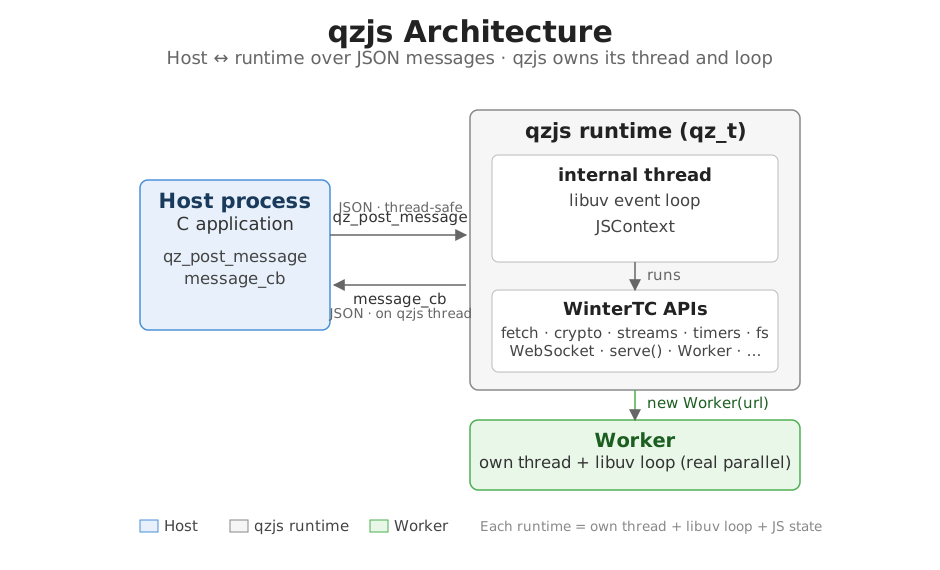
- WinterTC standard runtime — fetch, crypto.subtle, streams, timers, fs, serve() as globals
- Message-based host boundary —
qz_post_message(in) /message_cb(out), JSON in both directions - Isolated runtime model — each instance runs JS on its own internal thread; internal locks and atomics coordinate the thread, host, and worker boundaries, never JS execution
- ECMAScript engine (ES2023) — full ES2023 support, fast startup, low memory
- WinterTC-compatible runtime —
fetch,console,crypto.subtle,ReadableStream, timers,fs,URL,TextEncoder, WebSocket, and more - Native extensions — compression (miniz), crypto (mbedTLS), text codec, WebAssembly (WAMR, wasm3 optional)
- Zero system dependencies — all deps built from source via CMake; libuv is built from the deps submodule
- Multi-context + Web Workers — isolated contexts (soft suspend/resume to disk);
new Worker(url)runs a real parallel thread, or — with-DQZ_PROCESS_MODEL=ISOLATED, the default — a dedicated child process
The Host Integration Path
The Guide follows the order a host developer works in:
- Quick Start — build qzjs and run the minimal C embedding
- Host Integration — the full loop: create → messaging → lending capabilities → destroy
- Lifecycle — thread ownership, readiness, graceful shutdown
- Multi-Context — multiple isolated contexts in one runtime
- Extensions — register your own C functions as JS globals
- Bytecode — precompile JS to bytecode (faster startup, no source shipped)
When to Use qzjs
| Use Case | Why qzjs |
|---|---|
| Embedded / edge scripting | C99, tiny footprint, libuv event loop built in |
| Plugin systems | Per-runtime isolation, multi-context handled inside the runtime |
| Host applications needing scripting | Script your C app's behavior in JS without shipping Node.js |
| Edge compute | WinterTC APIs feel familiar to JS developers |
| Testing & simulation | mock_libuv for deterministic tests, no network needed |
When NOT to Use qzjs
- You need the Node.js module system — qzjs has no
require/importof Node built-ins. Many pure-JS npm packages work (runpython3 test/compat_check.py <pkg>(see Compatible Packages)); Node-only ones do not. - You need DOM — qzjs provides the WinterTC/W3C subset (fetch, WebSocket, streams, localStorage, ...) but no
document/window. - You need shared-memory concurrency — the main runtime is single-threaded; Web Workers run real parallel threads or processes but communicate via structured-clone messages, not shared memory.
- You need JIT performance — qzjs's engine is an interpreter, not a JIT compiler.
Project Structure
qzjs/
├── include/qzjs/       # Public headers (qzjs.h)
├── src/                 # Core runtime
│   ├── qzjs.c           #   Core API (create/destroy/post_message)
│   ├── thread.c         #   Internal thread + libuv loop
│   ├── uv_io.c          #   libuv I/O (network, fs, timers)
│   ├── msgq.c           #   Message queue (host ⇄ runtime)
│   ├── worker.c         #   Message dispatch (onmessage/postMessage)
│   ├── bridge.c         #   JS ↔ runtime bridge
│   └── context.c        #   Multi-context
├── polyfill/src/        # WinterTC module source